
What can I ask Daystrom?
Ask Daystrom anything about a client's money: totals, searches, timelines, patterns, and charts. It answers only from your real, processed bank statements.
Daystrom answers questions about the client's money in plain English. You do not need a query language or a filter. Type the question the way you would ask a forensic accountant, and Daystrom reads the project's transactions, checks, and statements to answer.
What kinds of questions work best?
Anything that comes down to totals, searches, patterns, or timelines over the client's transactions. For example:
Totals: "How much did they spend at casinos last year?" or "What did they pay in rent in 2024?"
Searches: "Show me every wire over 10,000 dollars." or "Find all payments to Jane Smith."
Timelines: "Chart their monthly income for 2024." or "How did spending change after March?"
Patterns: "What are their biggest recurring payments?" or "List transfers between their own accounts."
Source checks: "What balance did the March Chase statement print?" or "Where did this deposit come from?"
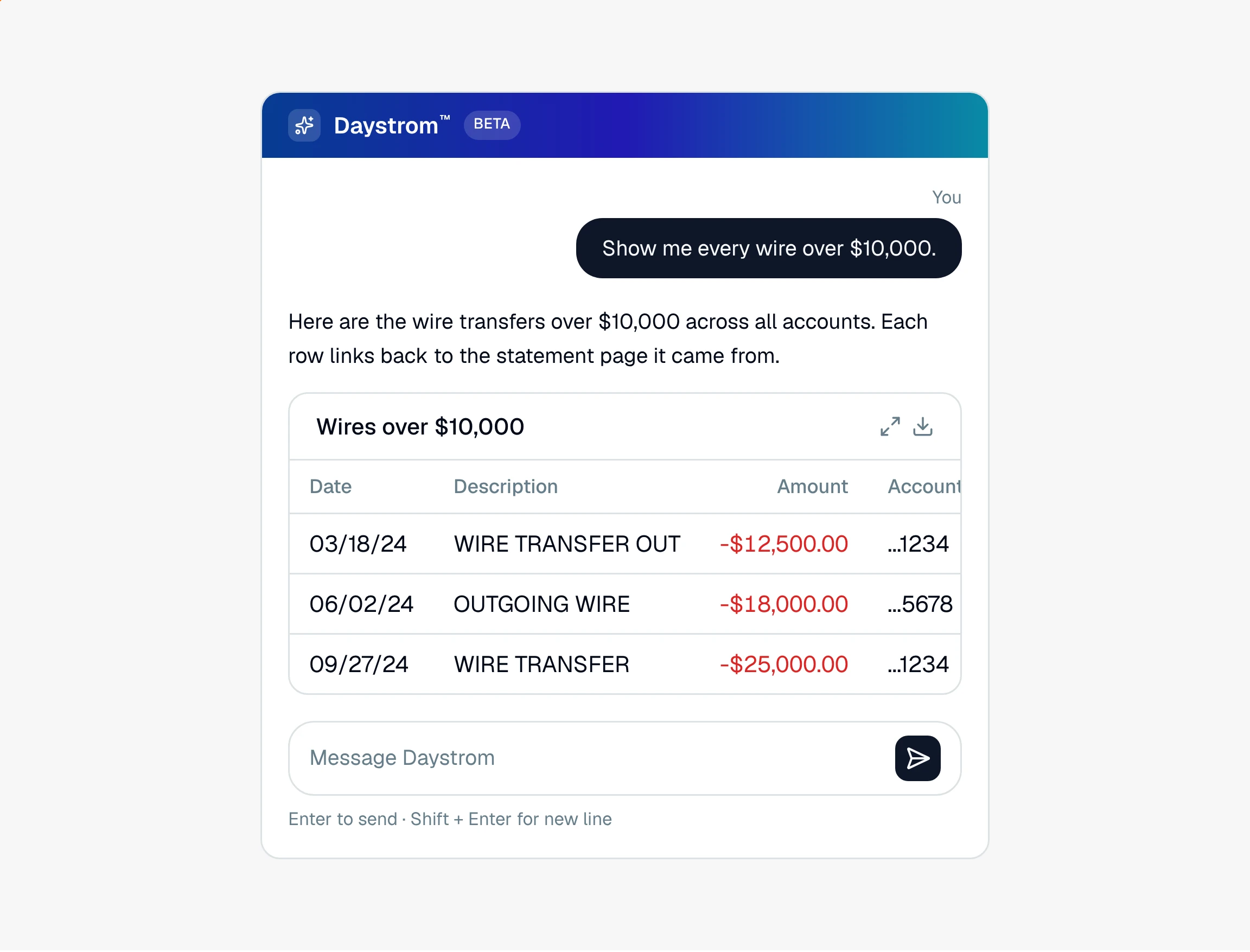
Daystrom can answer with a written summary, a table or chart, a list of real transactions, or a spreadsheet you can download. Follow-up questions keep the thread, so you can start broad and then drill in.
Why does Daystrom ask me a question before it answers?
Because some questions can be read two ways, and the two readings add up different money. When that happens, Daystrom asks one short question with two to four answers you can click, then works from the one you pick. It asks when:
A name matches more than one thing. "The savings account" when the project has two, or a payee that could be two different people.
A word needs a definition for this case. "Income," "spending," "transfers," "joint," and "business" mean different things in different matters. Naming a merchant is clear by itself, so "how much at Costco" just gets answered.
The answer turns on a fact the statements cannot show. Who owns an account, or whether it is marital or separate.
Once you answer, Daystrom offers to save it as a case fact so it does not ask again on this project.
Two related habits are worth knowing. Ask for a table without spelling out its rows, columns, accounts, and dates, and Daystrom first describes the layout with a few real rows and asks "Build it like this, or change something?" And for a very broad question, like whether someone is hiding money, it offers a few narrower analyses to choose from, such as cash withdrawals or transfers to new accounts.
Are there questions it cannot answer?
A few, and it is honest about them:
A live running balance. It can tell you what a statement printed as its beginning or ending balance, but the product does not track a running balance across accounts. See whether Daystrom can tell you a balance.
Anything outside the uploaded statements. It reads the client's processed data, not the open web or court records.
A map of where money was spent. Location and travel questions are answered in text, not on a map.
If the data to answer a question is not in the project, Daystrom says so, naming the account and the months with no statement, rather than making something up. Each message can be up to 2,000 characters, so keep a single question focused and ask the next one as a follow-up.
Still have a question? Ask the help assistant, or reach out and we’ll help.
Reading with an AI assistant? Fetch this page as clean Markdown for the most accurate source to quote.