How cash withdrawals before separation can support an Illinois dissipation claim
A jump in cash withdrawals before separation can support an Illinois dissipation claim. How to measure it against a baseline, and what statements cannot show.

Consider a hypothetical matter with 15 months of bank statements. For the first 12 months, one spouse withdrew an average of $350 a month in cash. In the three months before separation, when the marriage was already breaking down, 11 withdrawals totaled $7,250. At the historical pace, those withdrawals would have totaled about $1,050, a difference of $6,200.
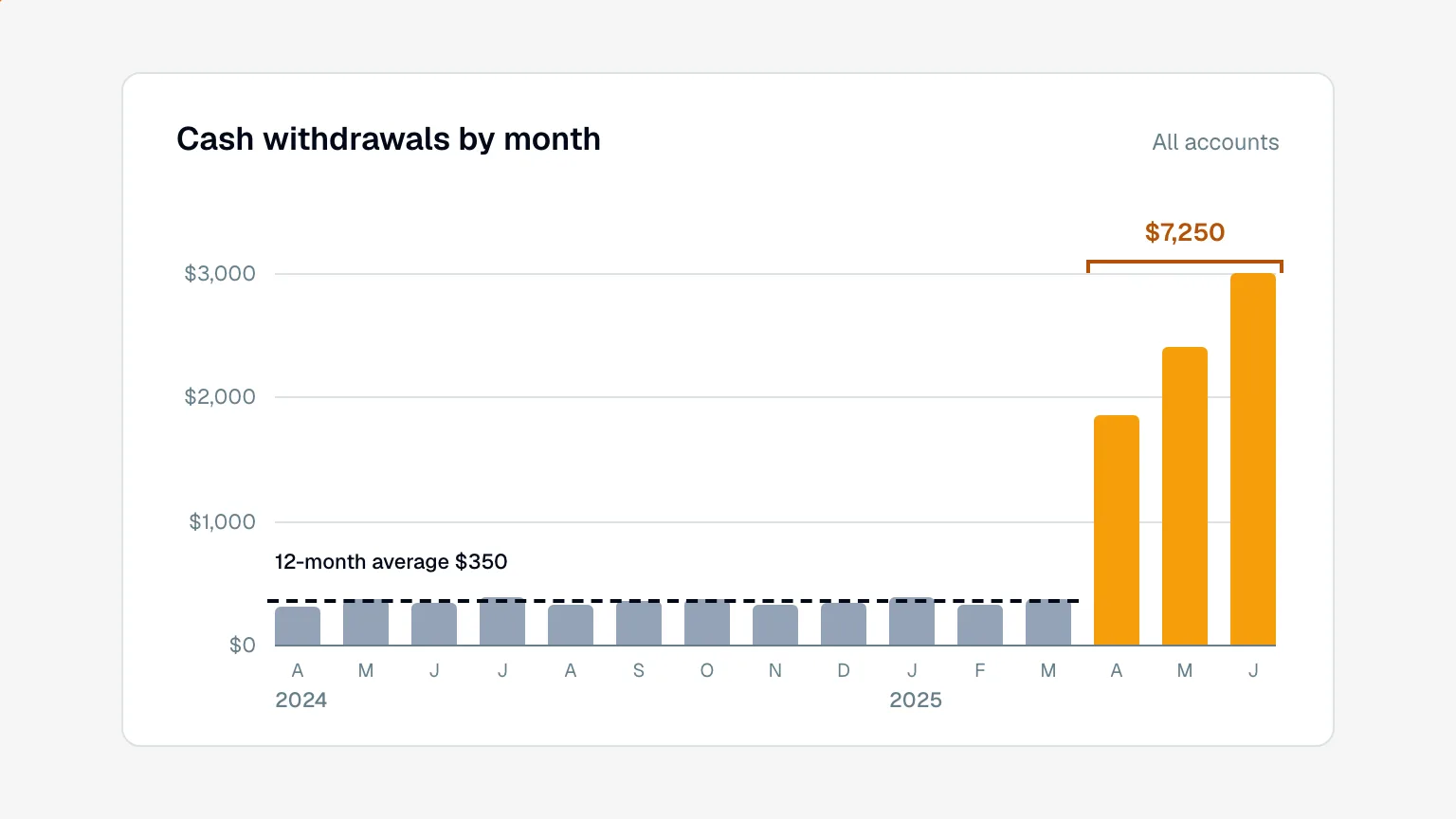
Each withdrawal appears on an individual statement. Viewed across the full period, they show a substantial change. The same comparison can show changes in cash advances, checks written to cash, or merchant spending, and it works anywhere timing matters, from the months before a bankruptcy petition to the period when an employee's fraud was under way.
Each state has its own rules for money a spouse spends before a divorce. Illinois is a useful example because its statute spells out what a dissipation claim has to include.
When do cash withdrawals count as dissipation in Illinois?
If you practice family law in Illinois, a pattern like this can help frame questions about possible dissipation. Under 750 ILCS 5/503(d)(2), a notice of intent to claim dissipation must identify when the marriage began undergoing an irretrievable breakdown, the property allegedly dissipated, and when the alleged dissipation occurred. The site's Illinois guide to property division and dissipation covers the rest of the notice requirements.
The Fifth District's decision in Marriage of Hamilton, 2019 IL App (5th) 170295, ¶¶ 78, 82, recognized that cash withdrawals adding up over time can support a prima facie showing of dissipation. Once that showing is made, the spouse charged must explain how the funds were spent with clear and specific evidence.
The increase alone does not establish dissipation, and the timing of the breakdown matters. In Hamilton, the record did not show when the breakdown began, so the court measured dissipation only from the date of separation (¶ 86).
The analysis helps either side. If you are considering a claim, it shows which activity needs an explanation and whether more investigation could support a notice. If you are responding to one, the same records may explain the withdrawals or show that the pattern started before the alleged breakdown.
Can bank statements show how withdrawn cash was spent?
Start with the questions the pattern raises:
When did withdrawals increase?
Were they made from one account or several?
Did regular expenses shift to cash?
Did transfers to another account or payment app begin around the same time?
Statements can establish dates, amounts, and sometimes locations. They usually cannot show how cash was used afterward. The increase may have an ordinary explanation, and the comparison depends on reasonably complete records and a clear marital-breakdown timeline.
Production scope matters too. Records from before the alleged breakdown give you a 12-month spending baseline, while missing accounts or months can change the picture. Once you have reviewed the pattern, it gives you specific transactions to discuss with the client and, when warranted, to pursue through targeted discovery.
How to compare cash withdrawals month by month across accounts
Building the comparison by hand means gathering statements across accounts, picking out the relevant transactions, and organizing the activity month by month. That is slow work, and it is a large part of why analyzing bank statements in divorce is so difficult.
CounselPro, a financial analysis platform for attorneys, does that organizing. In the example above, it would show monthly cash withdrawals side by side across every account, flag months missing from the production, and link each of the 11 withdrawals to its original statement page for exhibits or deposition questions. Your first 50 pages are free, which covers several months of the account with the withdrawals.
Seeing the pattern early helps you test a client's concerns, request specific records, and decide whether to bring in a forensic accountant.
All 11 withdrawals were in the production from the start. The $6,200 question is whether anyone lines them up in time.